

THE TUGBOTTOM PAPERS Dispatch No. 7
Congress Tries to Fold Homeland Security Like a Bad Hand of Cards Reorganization, reinvention, and the fine art of shuffling decks without dealing a new game

Congress assembled this week to chew over a daring scheme to eliminate the Department of Homeland Security, not by questioning its purpose, but by redistributing it like unwanted fruitcake at a holiday swap.
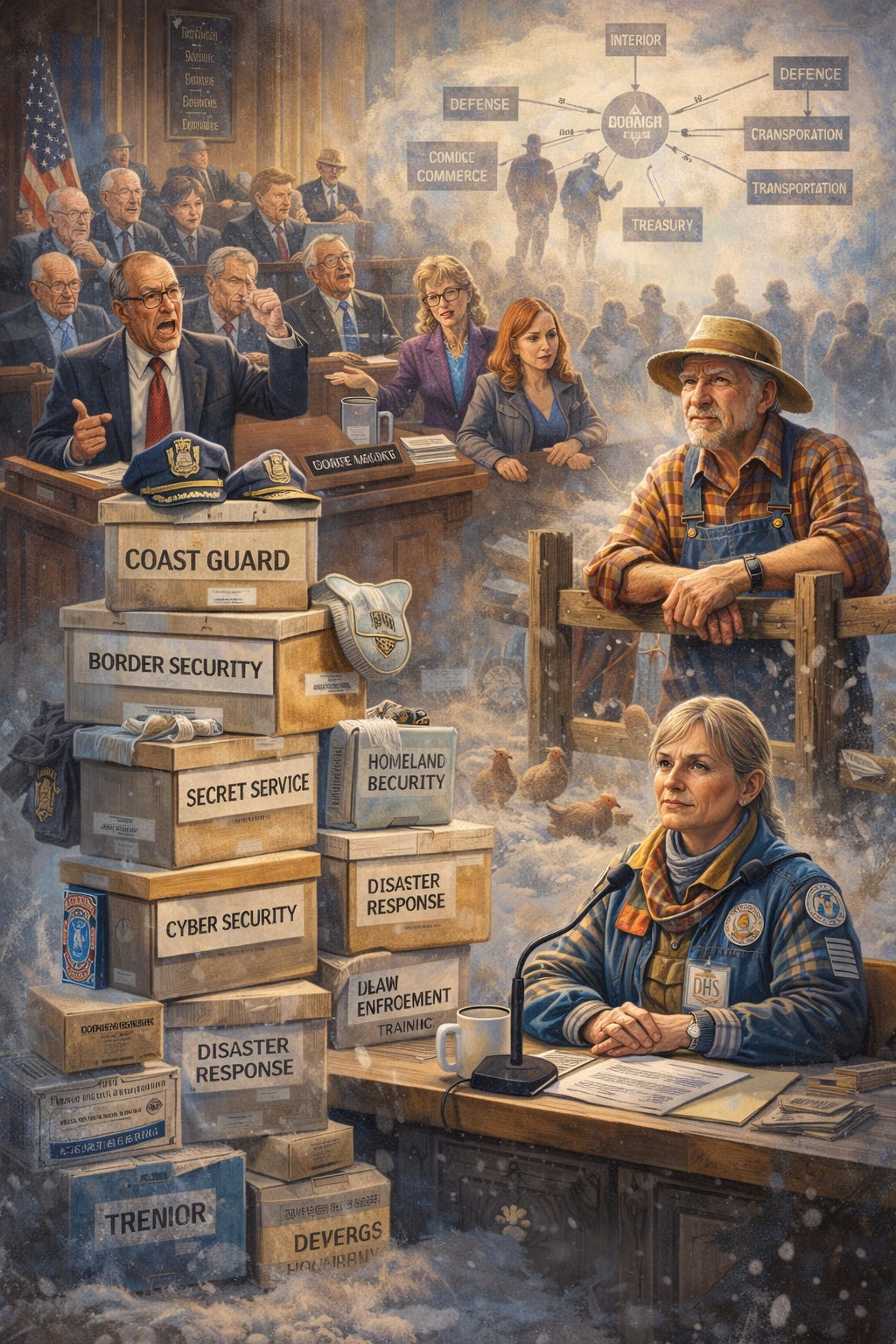
The idea was pitched as a tidy fix for waste, overlap, and the irritation of cramming too many initials under one leaky roof. It promised thrift, clarity, and a brighter future where responsibilities would be scattered across the bureaucracy like confetti after a poorly planned parade.
Representative Buckley Ledgerline of Upper West Pennsyltucky praised it as “a long overdue sweep out of the federal attic.”
“We’re not scrapping homeland security,” he said. “We’re just rediscovering it in somebody else’s drawers.”
Senator Prudence Wainscot of the Great Plains Corridor nodded along, observing that the department had swollen like a forgotten loaf.
“DHS has become the government’s catch all bin,” she said. “We’re just sorting the contents.”
The contents were extensive.
Immigration control would move to the Department of the Interior, combining people, forests, and wildlife in what one aide called “a one stop shop for frontiers.”
Disaster relief would follow, on the logic that floods, fires, and hurricanes usually happen outdoors.
Transportation security would return to the Department of Transportation, reuniting pat downs with potholes and traffic cones.
Cybersecurity would be divided between Defense and Commerce, ensuring no single agency ever had the full picture.
The Coast Guard would become fully military, except when it was not.
The Secret Service would return to Treasury, its original home, presumably to stay closer to the money it chases.
Law enforcement training would consolidate under the FBI, unless the FBI was busy.
Everything else would be assigned to a board, council, or committee yet to be named.
Representative Lila Posture of Coastal Nouveau applauded the plan’s ambition.
“This is democratic capitalism at full throttle,” she said. “Progress by parcel post.”
Senator Clyde Drumworth of Old River North warned the transition would take time.
“We’re looking at a careful two to three year rollout,” he said. “Longer if anyone starts asking questions.”
At the witness table sat Secretary of Homeland Security Shelley Cosplay, dressed in what aides described as emblematic readiness: a windbreaker, tactical boots, and a scarf bearing a DHS logo retired several fonts ago.
“Homeland security isn’t a building,” she said. “It’s a mood.”
She assured lawmakers the department supported its own dissolution, provided it happened slowly, thoughtfully, and with generous funding for transition consultants.
“Our mission won’t miss a beat,” she promised. “It will simply operate elsewhere.”
Asked whether dismantling the department might leave gaps in coordination, Secretary Cosplay smiled.
“That’s the beauty of teamwork,” she said. “We’re confident someone will be in charge.”
Senator Malcolm Quibble of Inland Tidewater raised a concern.
“If everyone’s responsible,” he asked, “who’s accountable?”
The question was referred to a working group.
The Speaker of the House hailed the proposal as visionary.
“This is reform with flair,” she said. “Not demolition, but redistribution until no one feels targeted.”
She added that Americans could rest easy knowing nothing essential would disappear, aside from a few org charts.
President Flannoggin offered a brief statement.
“Democratic capitalism loves a good pivot,” Flannoggin said. “By scattering homeland security, we’re making it stronger, leaner, and harder to find.”
Cable pundits reacted instantly.
One panel called the plan overdue. Another called it reckless. A third spent twenty minutes debating whether Interior could manage both grizzlies and green cards. All agreed the argument itself counted as progress.
By week’s end, the bill vanished into committee, where it would be studied carefully until a more exciting crisis arrived.
Meanwhile, in Tugbottom Country
Farmer Jedediah Tugbottom read the story over his morning coffee.
“They’re not fixing anything,” he said. “They’re just relabeling the mess.”
He folded the paper.
“When you break something into enough pieces,” he added, “eventually nobody remembers how it worked.”
He went out to mend the fence. It needed fixing. He fixed it anyway.
The chickens watched, satisfied that at least one creature understood boundaries.
Running Tugbottom Observations
Reform looks best when it involves moving boxes.
Harmony thrives when ownership is optional.
Every reshuffle promises clarity and delivers meetings.
If responsibility is everywhere, it is nowhere.
Democratic capitalism prefers motion to direction.
Committees are where urgency goes to nap.
Quiet failures are rebranded as efficiency.
If nothing is eliminated, nothing is solved.
Tugbottom’s Final Word
“You can scatter responsibility to the wind,” Tugbottom said, “but sooner or later somebody still has to answer the door.”
From the Republic of Banana to whatever porch this reaches, The Tugbottom Papers observe that government loves reorganization because it looks like action, sounds like progress, and delays both.
Next week, the committees may report back. Or they may not. Either way, the boxes stay neatly labeled.